
Walk a Minneapolis Street by Address
A Minneapolis street search works best one parcel at a time. Hennepin Property Information Search connects a street address to assessment, tax, parcel-description, sale, map, and limited recent-recording information. The City Address Portal adds municipal context for the same location. Neither result establishes that a named owner lives at the address. An owner may be an estate, lender, business, trust, or former owner, while an address result can represent a whole building rather than a unit.
Keep a dated note of the address spelling, the parcel ID, and the result type before moving on. The county updates its property database on weekday evenings, and the public site is intended for individual parcel searches, not bulk downloading. That simple record of what was searched makes it easier to tell a changed address from a changed result.
- Enter the house number and street name in Hennepin Property Information Search. Save the 13-digit PID, legal description, assessment date, map link, and any recent recording-history entry.
- Run the same location through the Minneapolis Address Portal. Its Address or Property ID field, optional unit field, and Search control can attach civic and service context to the address.
- For an ownership document, use the Hennepin County Recorder / Registrar of Titles index. Match the document or certificate number and recording date before requesting a copy.
- Use voter registration only as an individual status-confirmation route, with the person’s name, date of birth, address details, and permitted purpose. It is not a block-by-block name list.
- When the question is historical, search the address in Hennepin Library’s digitized directories and compare nearby publication years. A dated directory hit is evidence of an address association at publication time, not proof of a current occupant.
Note: A recorded owner, a directory listing, and a voter confirmation answer different questions, so retain the source date and avoid treating any one as a complete household list.
Minneapolis Street Directory Search Fields
Hennepin’s property tool offers three practical ways to reach a Minneapolis address. The main mode requires a house number and street name and permits a unit number. A PID route is helpful after an address has changed or a building has been split. The addition-name route uses lot, block, and an abbreviated addition name. Street-name searches need at least three characters, and published tips recognize common abbreviations and directional forms such as “14th St E.”
| Hennepin field | Type | When it helps | Format note |
|---|---|---|---|
| House number | Required address text | Starts a Minneapolis street directory search | Use with street name |
| Street name | Required address text | Finds a parcel on the named street | At least three characters; try the county’s abbreviations |
| Unit number | Optional text | Refines a building result | Try the master address first if a unit fails |
| PID | Property identifier | Connects the parcel across address changes | 13 digits; spaces and dashes may be omitted |
| Lot, block, addition | Alternate search fields | Helps with plats and older parcel descriptions | Addition names are abbreviated in the database |
Results can show tax status and amounts, assessment values, parcel description, sales, recent recording history, and a map. The county’s detailed search tips do not establish an online historical cutoff for these results, so an absence should be recorded as an absence from the current interface, not as proof that no older record exists. The automated PID phone lookup at 612-348-3011 is available daily from 7 a.m. to 9 p.m. Property-tax counter service is generally available weekdays from 8 a.m. to 4:30 p.m.
A view of the Hennepin property search shows the address, PID, and addition paths used for a Minneapolis street directory search.
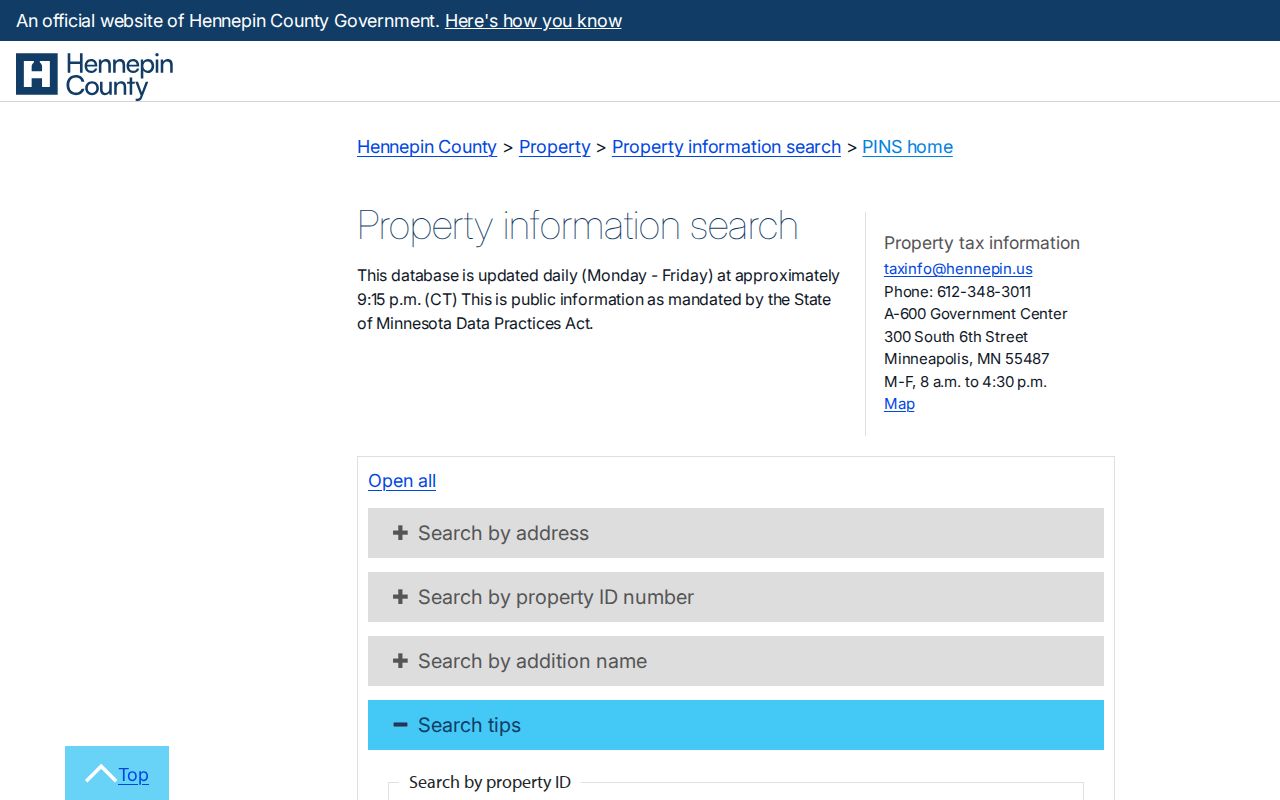
Use the displayed field labels as a prompt to try the address and parcel variants, rather than assuming the first spelling is the only valid one.
Minneapolis Addresses Can Change
The city’s Street Naming and Address Standard explains why an old street reference may not match a modern search. Minneapolis changed its language from building numbering to parcel and structure numbering in 2004. The standard treats an address as an attribute of an ownership parcel and sets rules for addressing structures, units, subdivisions, street vacations, structure moves, and parcel changes.
A shared-lobby building may retain one master address with suite or unit identifiers. Separate exterior entrances can receive separate addresses. Subdivision, parcel combination, and a moved structure can also separate a historic directory number from the present-day parcel result. Try the historic number, direction at the end of the street name, a recognized street abbreviation, neighboring numbers, and then the PID or lot/block/addition route. The City Address Portal can be particularly useful because it accepts an address or APN with an optional unit.
The Minneapolis Address Portal presents the city’s address and APN route for this part of an address search.
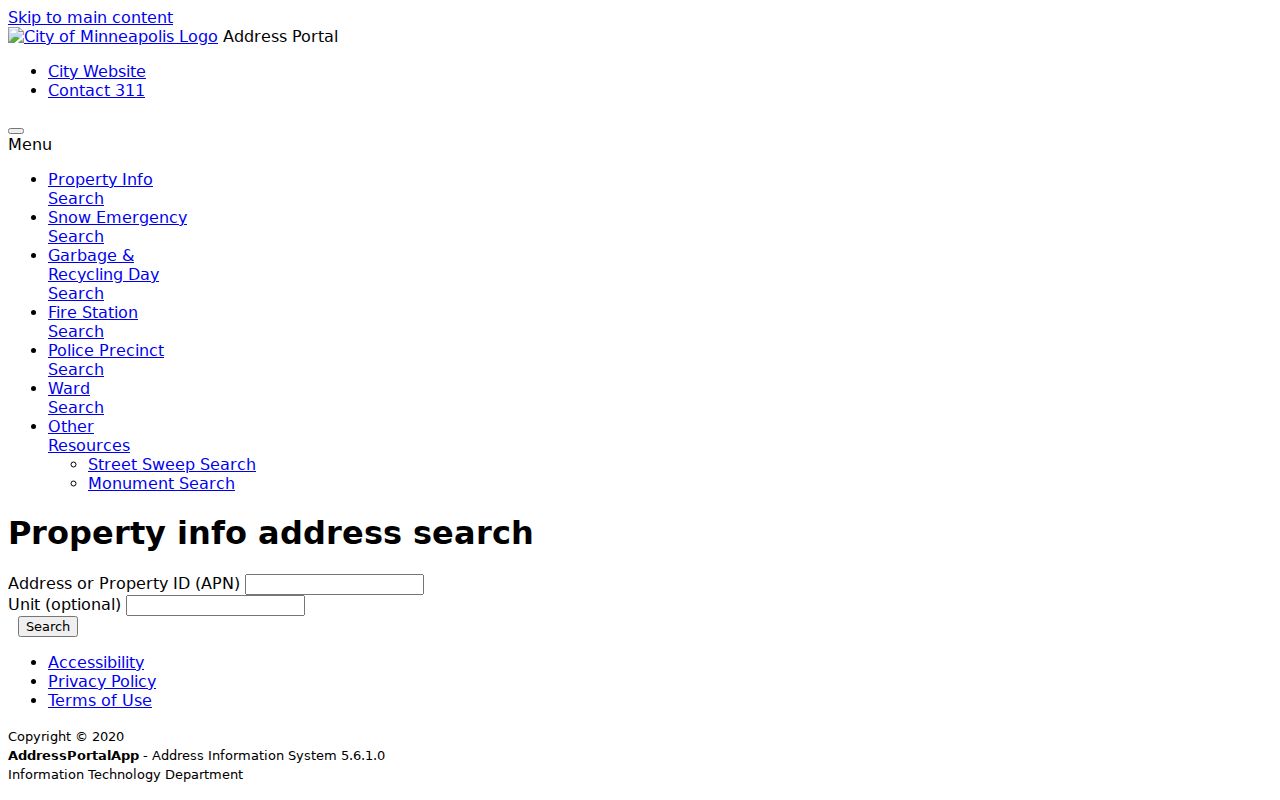
The portal’s links to ward, precinct, fire, garbage, snow, street-sweep, and monument information add context, but they do not identify every person at an address.
Note: A ZIP code, ward, neighborhood, police precinct, and parcel each describe a different boundary, even when they all attach to the same Minneapolis street address.
Permit Cards by Minneapolis Street
For a structure history, Hennepin Library’s Researching Homes in Hennepin County connects a Minneapolis address to permit cards, lot surveys, maps, atlases, Sanborn sheets, aerial photographs, plats, and local-history help. Permit cards cover 1884 through 1973. The city permit index covers 1974 through 1989, and building and wrecking permit records are described as 1884 to the present through later systems. These materials describe the structure and its documented work, not a current household roster.
The digitized permit-card collection includes original hand notebooks created by WPA workers in the 1930s and later city staff records. One official item covers 15th Street East street numbers 0 through 999, which shows why an exact house-number search can miss an address that is filed by a range. When a result is unclear, compare the street range with a plat, the parcel’s legal description, and the address history.
The 15th Street East permit-card item illustrates how Hennepin’s historical collection can group a Minneapolis street by number range. Once a permit or map identifies the parcel, the recorder index is the right next step for a recorded document, while the library collections retain the address-history layer.
Deeds Along a Minneapolis Street
The Recorder / Registrar land-title system is the custodian for deeds, mortgages, liens, releases, documents, and certificates. PINS may show only the last five years of recording history. That is a useful recent pointer, not a complete chain of title. Begin with the PID and legal description, inspect the recent entry, then use the recorder index and request the actual instrument when an older document matters.
Several access channels are available. RecordEASE Public Search provides a limited free index. RecordEASE Pro requires an agreement, generally takes one to two business days to enable, and charges $2.50 per document, certificate, or plat. Public kiosks at the Government Center are free for searches during county hours. An owner may request a free electronic deed or certificate by emailing recordsrequest@hennepin.us. Virtual Recorder is an account-based purchase path with a $3 service fee plus record fees. Mail requests require the document or certificate number and type; the county lists $1 per page for a noncertified document, $10 for a certified document, $10 for a noncertified plat, and $15 for a certified plat. Credit cards are not accepted by mail.
The Recorder / Registrar access page shows the index and copy routes used after a street search has produced a parcel or document reference.
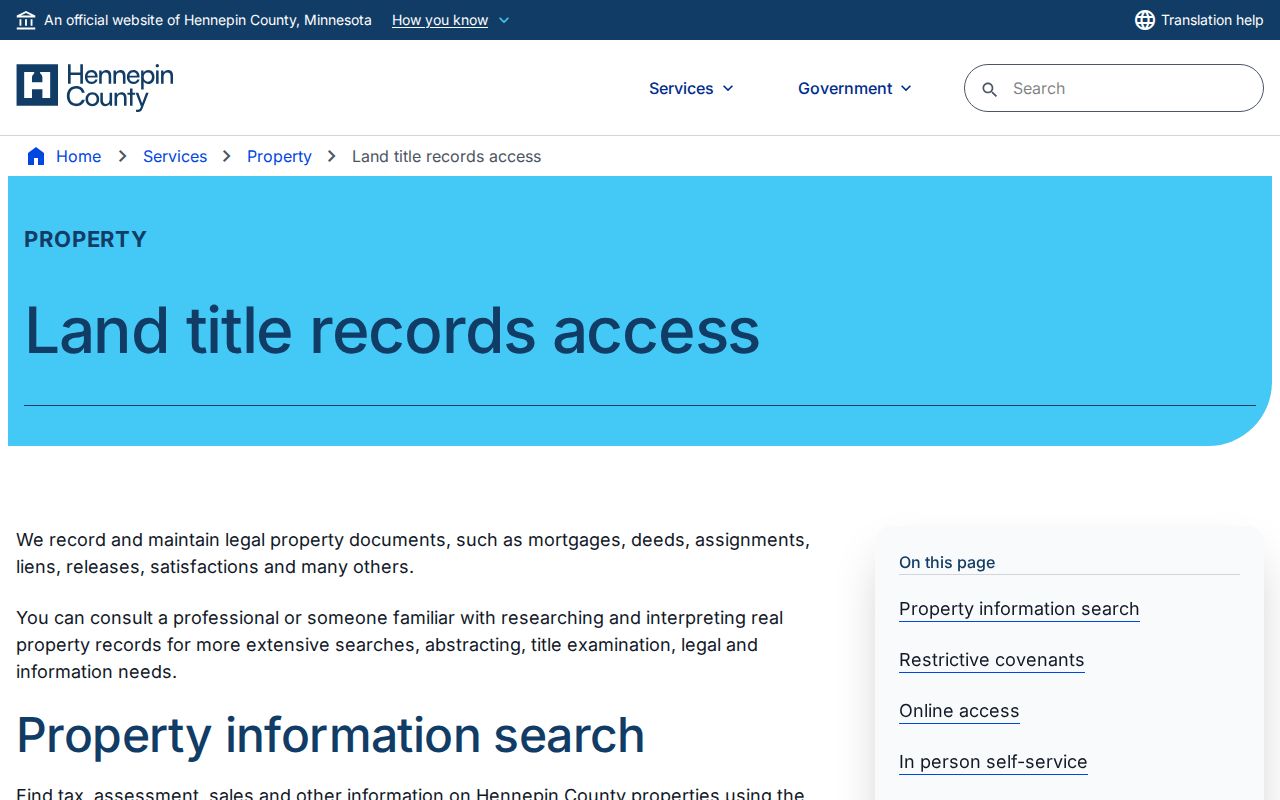
Match the grantor or grantee name, document type, recording date, and legal description before drawing any conclusion about an address relationship.
Minneapolis Street Records at a Glance
Address-keyed sources overlap, but their limits matter. Property records are strongest for the parcel and reported owner. Municipal address tools are strongest for city-service context. Recorder documents record an interest in land. Library sources can place an address in a historical year. Voter data have their own restricted access rules, so the public registration tool is for confirming an individual record rather than creating a street roster.
| Address source | What it can establish | Custodian | Access route |
|---|---|---|---|
| Property Information Search | PID, parcel description, tax, assessment, sales, map, limited recent recordings | Hennepin County | Online, automated PID phone line, or counter |
| Address Portal | Address/APN context and city-service links | City of Minneapolis | Online address or APN search |
| Land-title index | Recorded documents, certificates, liens, releases, and copy paths | Recorder / Registrar | Free limited index, subscription, kiosk, email, Virtual Recorder, or mail |
| Registration records | Status confirmation for an individual at an address | Minnesota Secretary of State and Hennepin County | Official lookup or restricted county data request |
| Permit cards and maps | Structure, work, lot, and historical address context | Hennepin Library and city sources | Digital collection, Special Collections, and research assistance |
Minnesota’s registration lookup requires first and last name, date of birth, and ZIP or county mode, with house number, street selection, and unit details when applicable. A Hennepin voter-data request goes through the county’s data-request route and requires a registered Minnesota voter, photo ID, and the statutory permitted-use statement. Under Minn. Stat. §201.091, the list cannot be republished as a searchable online copy, sold, lent, or used outside the permitted purposes.
Minneapolis Street Directory Terms
Address research is clearer when the record terms are kept separate. The following terms recur in Hennepin property, recorder, and library material.
- Parcel
- A tax and land-record unit. Hennepin identifies it with a 13-digit PID.
- Legal description
- The formal land description used in recorded and parcel records, often using lot, block, and addition language.
- Grantor and grantee
- The parties named in a recorded conveyance. Their presence in a deed records an interest, not present occupancy.
- Address portal context
- City information linked to an address or APN, such as ward or service details, rather than a resident list.
Hennepin’s Property Watch is also worth distinguishing from a title search. It is a free owner-alert enrollment service using a house number, address, or PID and an email address. It can alert an enrolled owner to a recording-related event, but it does not replace a review of title documents.
The property-alert enrollment view is supplied by Hennepin Property Watch.
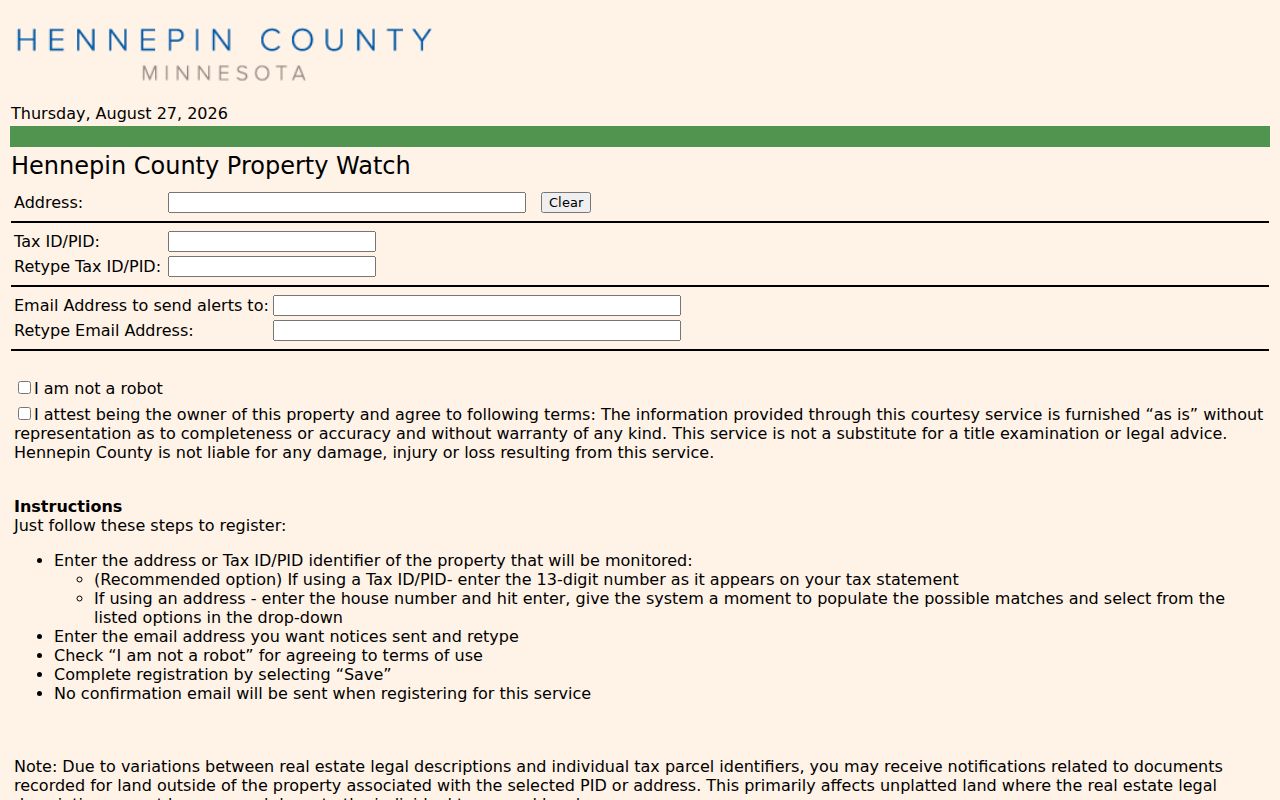
For a document question, use the alert only as notice and return to the recorder’s index or copy channel for the underlying record.
Note: Hennepin’s property tools prohibit bulk scraping, so each Minneapolis street inquiry should stay limited to a legitimate, individual record need.
Limits of a Minneapolis Street Directory
A Minneapolis street directory cannot prove who currently occupies every address. Parcel data can show an owner or mailing address. A deed can record a transfer or other land interest. An address portal can describe civic context. A historical directory can show an address association at a particular publication date. None automatically identifies all household members, confirms a person’s present location, or turns a protected address into a public one.
Minnesota’s Government Data Practices Act starts with a public-data presumption, but specific classifications narrow access to voter, birth, court, law-enforcement, and Safe at Home information. The Safe at Home program uses a designated address and mail-forwarding service for participants who need protection. Never treat that designated address as a person’s physical location. Federal motor-vehicle privacy law also restricts disclosure and use of personal information from state motor-vehicle records.
Lawful use. Use Minneapolis address records for personal, civic, property, or historical research within each custodian’s rules. Do not use records to stalk, harass, intimidate, dox, or harm anyone.
For a dated historical household question, the digitized runs and Special Collections access are described on the Minneapolis city directories page, rather than in a modern parcel result.