
Minneapolis Directory Sources
Hennepin Library makes the main Minneapolis directory run available from 1859 through 1963. Its digital collection supports name and address searching, browsing, and downloads where a collection permits. The ResCarta browse host shows early volumes such as 1859-60, 1865-66, 1867, 1869, and 1871-72, followed by annual or near-annual material into the twentieth century. That sequence is useful, but a title appearing in a browse result is not proof that every intervening year survives. Check the volume, year, and scan before relying on a hit.
| Minneapolis collection | Years | Where held | How to use it |
|---|---|---|---|
| City directories | 1859-1963 | Hennepin Library Digital Collections and ResCarta | Name or address search, browse, and collection downloads where available |
| Area phone books | 1933-1975 | Hennepin Library digitized collection | Searchable by address or last name within a volume or across the collection |
| Yellow Pages | 1933-1963 | Hennepin Library digitized collection | Separate subscriber and commercial context, not a household roll |
| Directories, maps, and yearbooks | Item-level scope varies | Hennepin History Museum archives | Use the catalog or finding aid for a specific item |
The library's 2026 announcement also identifies Minneapolis Chamber and civic publications, including Minneapolis - Metropolis of the Northwest for 1927-1932 and Greater Minneapolis from 1949 through 1979. They add civic and business context, but they are not interchangeable with the main directory run.
Searching Minneapolis Directory Scans
Use the Hennepin Library Digital Collections first when a surname, street, or approximate year is known. Basic search does not use quotation marks or Boolean syntax. Advanced search offers exact phrase and “Any of words,” plus facets for Subject, Creator, Source, Date Created, and Coverage-Spatial. A name search can miss an OCR error, so search the street address in the same year and the years on either side. The image, not the OCR snippet, is the record to read.
The directory-collection description confirms that entries can be found by name or address. It is especially useful to run both paths. A surname hit may establish a candidate household, while an address search can reveal whether the page context or a nearby year points to a move, a spelling variation, or a publication gap. Keep the publication year with every transcription.
Hennepin Library’s collection interface is shown in this source capture of its directory collection.
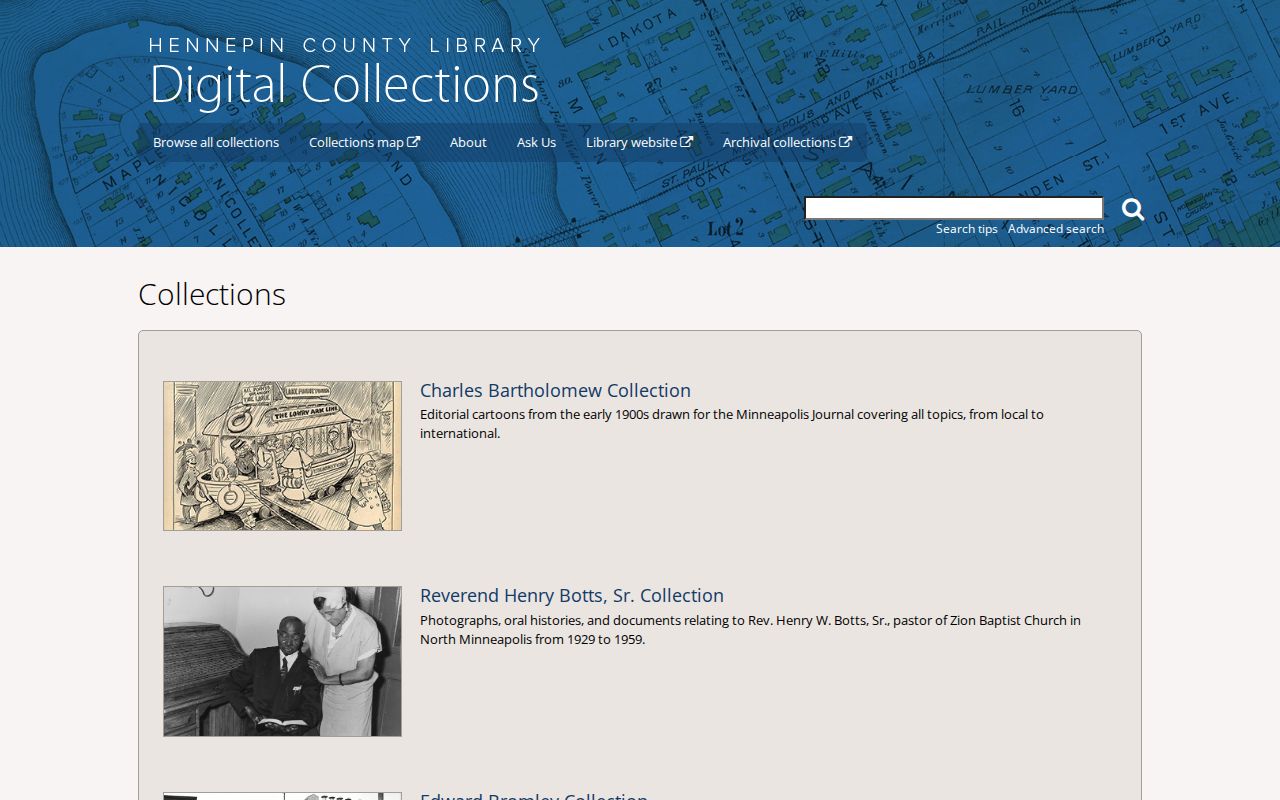
The available facets help separate a city directory scan from a photograph, clipping, or another historical item before a researcher records the result.
Note: A search result is a lead, so retain the volume title, page, search spelling, and date of retrieval with the image you inspected.
Minneapolis Historical Research Room
For material that needs closer reading, Hennepin Library Special Collections is on the fourth floor of Minneapolis Central Library. It holds Minneapolis and Hennepin books, photographs, yearbooks, archives, periodicals, maps, postcards, websites, and clipping files. No appointment is generally necessary, though advance contact makes sense for archival material. The collection lists specialcoll@hclib.org and 612-543-8200 for research contact.
Its broader Genealogy and Local History material includes census, church, military, newspaper, directory, photo, and map sources. That mix matters when one Minneapolis directory entry is unclear. A directory is only one dated publication. A permit card, map, newspaper notice, census entry, deed, or neighborhood archive can support or weaken the connection without turning a single line into a claim about a whole household.
Hennepin Library Special Collections
Fourth floor, Minneapolis Central Library. Directories, maps, yearbooks, archives, and clipping files are among the local research material.
Hennepin History Museum Archives
The archive research library holds local directories, maps, photographs, letters, blueprints, diaries, yearbooks, and newspapers.
Minneapolis Archive Desk Access
The Hennepin History Museum archives add a second local path when the library scan does not settle a question. Its research library has one computer with free Ancestry and Minneapolis newspapers.com access. Directories, photographs, maps, letters, books, blueprints, diaries, yearbooks, and postcards can put an address or name in a wider historical setting. The public capture did not identify the earliest year for every archival subgroup, so use the museum catalog or finding aid for item-level scope.
This source image of the Hennepin History Museum research library shows the archive setting.

A museum directory or newspaper reference should be cited as that collection's dated material, then compared with an independent Minneapolis source when identity matters.
Reading Minneapolis Directory Results
A specific Minneapolis directory page and its exact entry fields were not exposed in the research capture, so a familiar-looking abbreviation should not be guessed. Instead, record only what the scan actually displays and preserve the title page or publisher data. Hennepin's collection description confirms name and address searching, while the library warns through its search design that OCR is merely a way into the scan. The entry needs its page context, especially when several people share a surname or an address changes format.
| Volume identity | Record the directory title, year, publisher if shown, and the scan or item link. |
|---|---|
| Search path | Note whether the finding began with a name, an address, a browse path, or an OCR result. |
| Visible text | Transcribe only the name, address, initials, or other wording that is legible in the page image. |
| Page context | Read surrounding entries because household grouping, abbreviations, and OCR can mislead. |
| Cross-check | Compare a nearby year, map, permit, census, deed, or newspaper item before reaching a conclusion. |
- Directory scan
- The image of a historical volume. It carries more context than a text-recognition hit.
- OCR
- Text generated from a scan. It can make a volume searchable but can misread names and address abbreviations.
- Collection record
- The library description for an item or volume. It identifies the object but is not the same thing as the page within it.
Note: A phone-book subscriber, a Yellow Pages listing, and a directory entry have different publication purposes and should be labeled separately.
Minneapolis Directory Publishing Clues
Minneapolis directories were annual or biannual as early as 1859, according to the University of Pennsylvania Online Books serial record, and titles and publishers varied. Hennepin's Minneapolis music-history PDF identifies a Minneapolis Directory Company volume in 1946, R.L. Polk & Co. examples for 1950, 1955, 1960, 1965-66, 1970, 1975, 1980, 1985, and 1990, and a Cole Publications example in 2000. Those are anchors for distinguishing similarly titled records, not a claim that a complete run exists for each publisher.
| 1859 | Earliest documented issue point for the Minneapolis directory series. |
|---|---|
| 1946 | Minneapolis Directory Company example identified in the music-history PDF. |
| 1950-1990 | Selected R.L. Polk & Co. examples identified by the same source. |
| 2000 | Cole Publications example identified by the same source. |
| 1963 | Stated end of the Hennepin digitized Minneapolis directory collection. |
When a Minneapolis catalog result has a similar title, compare its displayed year and publisher with the volume image before treating it as the intended directory.
Tracing Minneapolis Directory Households
For family history, start with a name and a year, then follow the same person and street through adjacent directory volumes. When a surname search fails, reverse the approach and search the street address. Minneapolis directories can lag a move, repeat a name, abbreviate a person, or omit people such as boarders, children, women listed under a spouse's name, transient residents, and people the publisher missed. A disappearance from one volume is a reason to compare evidence, not a conclusion by itself.
- Find the closest Minneapolis directory year and save the scan, volume title, page, and exact search spelling.
- Search the same name and exact address in the preceding and following volumes, including alternate initials or spellings.
- Read the page around each hit, then compare the address with a permit card, plat, Sanborn map, or deed when available.
- Pair the directory year with federal or Minnesota state-census material to test household and address continuity.
- Use a newspaper, neighborhood archive, or museum collection as a final independent check when the trail changes.
The Hennepin ResCarta directory browse is useful for confirming which Minneapolis volume is being searched.
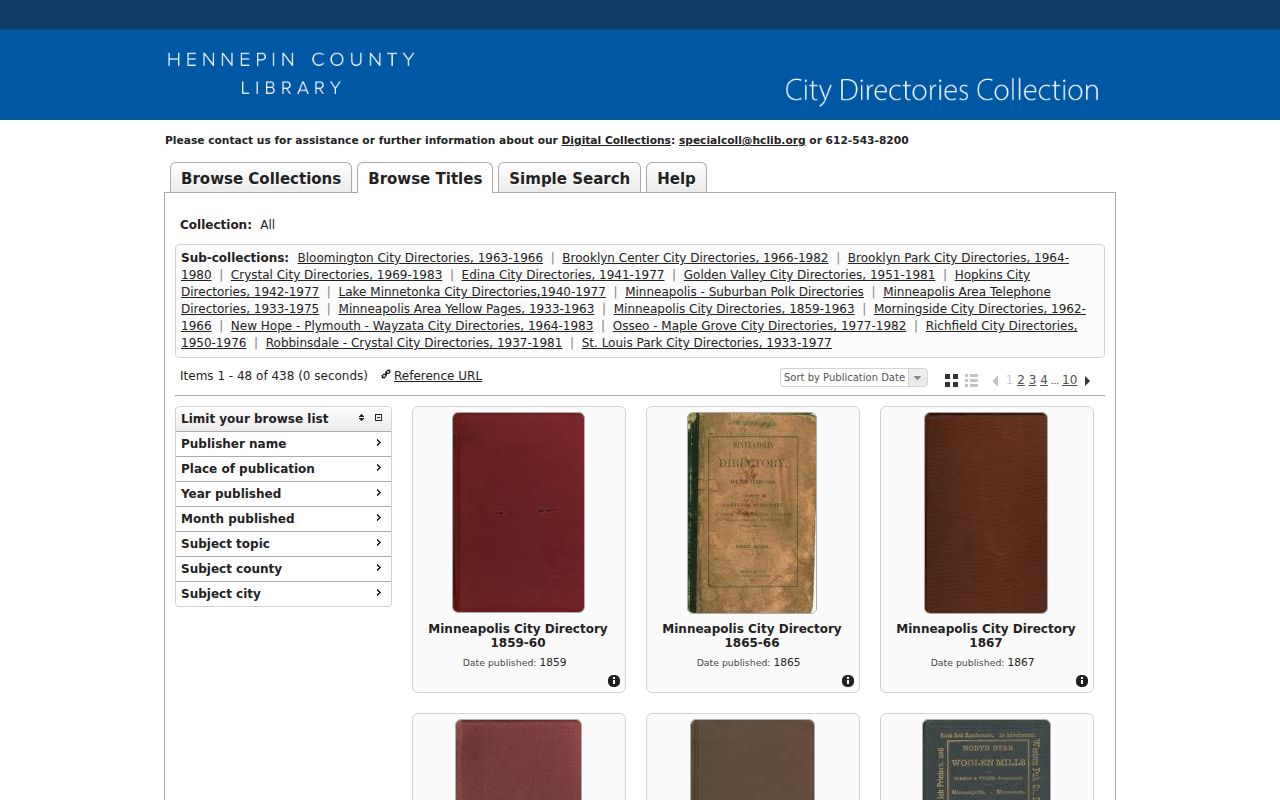
Browsing by title and year is a practical safeguard when an OCR result does not clearly identify its directory volume or publication date.
Minneapolis Directory Address Changes
Minneapolis address research becomes harder when a historic number no longer behaves like a modern search. The City changed from “building numbering” to “parcel and structure numbering” in 2004. Hennepin uses a 13-digit PID, addition names, lot and block fields, and direction forms such as “14th St E.” Historic records may use “Addn” or “Auditor’s Subd.” Search the old and current number, street abbreviation, direction, addition, lot, block, and PID before deciding that a directory entry is wrong.
Hennepin Library also points to 1912-based Sanborn material with later changes through about 1930, Minneapolis atlases from 1885 through 1940, aerial photographs from the 1920s-1970s, and permit cards from 1884-1973. These are structure and address-history tools. They help connect a historical directory address to a place without treating a current parcel record as proof of a current resident.
A historical address can fail in a current search for several ordinary reasons. A building may have moved, a parcel may have been split or combined, a new entrance may have received a separate number, or the directory may use an abbreviated street form. The city’s address standard assigns an address to a parcel or structure and has separate rules for units and shared lobbies. Start with the historic spelling and number, then compare it to the current PID, legal description, and addition information. Keep every normalization in the research notes so a later reader can tell the original directory text from the modern property description.