
Finding Minneapolis Residents From a Lead
Minneapolis has no open, all-purpose list of every resident. The useful record changes with the question. A current street address can be checked first against Hennepin property information, while a name from an older family photograph is often better suited to a digitized city directory. A court case, marriage index, or voter-status confirmation can help distinguish people with the same name, but each record has its own limits.
Start with a source that is tied to a date and keep that date with the result. A property record may name an owner, not a current occupant. A city-directory entry can place a household at publication time, but it can miss people or lag a move. That narrow reading makes a Minneapolis residents directory search more reliable than treating one hit as a complete answer.
- Search a known address or parcel in Hennepin Property Information Search and save the parcel ID, description, and record date.
- Use the city address tool for ward, precinct, service, and neighborhood context attached to that address.
- Check the Recorder/Registrar index when the question is about a deed, lien, mortgage, or other recorded instrument.
- For an older household, search the library directory collection by surname and then by the exact address in nearby years.
- Request an existing public record from the right custodian when the material is not available through an online index.
Minneapolis Resident Records Custodians
Most name-and-address evidence comes from Hennepin County or Minnesota offices, not a single Minneapolis department. The county property system connects an address to a parcel. The Recorder/Registrar holds recorded land-title instruments. Election staff handle requests governed by Minnesota voter-data rules. City departments can also receive a focused data request under the Minnesota Government Data Practices Act, but they need not create a new resident list.
Hennepin County Recorder / Registrar
Government Center, 300 South Sixth Street
Land-title records, public kiosks, copies, and RecordEASE access
Land Title Records Access
Hennepin County Property Information
Parcel, tax, assessment, sales, map, and recent recording information
612-348-3011 automated PID lookup
Property Information Search
Hennepin County Elections
Voter-data requests through the county data-request route
612-348-5151
Election Security and Data
Minneapolis Parcels Anchor the Current Search
Hennepin Property Information Search is the best first stop when an address is known. Its public form supports a house number and street name, an optional unit, a 13-digit property ID, or lot, block, and addition fields. Results can include tax status, tax amounts, assessment values, parcel description, sales, a map, and recent recording history. The county updates the database on weekday evenings and limits it to individual searches rather than bulk collection.
A Minneapolis address may need the street direction at the end, such as a form of 14th St E, and the street field needs at least three characters. Save the PID because it stays useful when an address has been divided, combined, or written differently in a historic source. The parcel result is evidence about property. It does not establish who occupies a home today.
| Hennepin field | How it is used | Useful result |
|---|---|---|
| House number and street | Find one address | Parcel and assessment record |
| Property ID number | Use the 13-digit county PID | Stable parcel identifier |
| Lot, block, addition | Resolve a legal-description lead | Subdivision-level match |
| Interactive map | Check parcel geography | Map and related property context |
Minneapolis Deed Searches Have Several Routes
The Recorder/Registrar is the authority for deeds, mortgages, liens, releases, certificates, and other recorded land-title documents. The public RecordEASE search is limited but free. People who need more access can use free public kiosks during county hours, apply for RecordEASE Pro, or request a document through the county’s copy channels. The property record’s recent recording history covers only the last five years, so it is a starting point rather than a full chain of title.
RecordEASE Pro normally takes one to two business days to enable and is listed at $2.50 per document, certificate, or plat. A property owner may request a free electronic deed or certificate copy by email. Virtual Recorder is an account-based purchase channel with a $3 service fee plus document fees. Mail requests require the document or certificate number and type; the listed mail fees are $1 per page for a noncertified document, $10 for a certified document, $10 for a noncertified plat, and $15 for a certified plat. The county does not accept credit cards by mail.
Recorded parties are not necessarily residents. A deed may name a lender, trust, estate, entity, purchaser, or prior owner. Use the instrument date and property identity to understand the connection it documents.
Minneapolis Address Context Before a Name
The City Address Portal accepts an address or property ID, with an optional unit. It is useful for separating city service context from county parcel data. Its linked menus can identify a ward, precinct, fire station, garbage and recycling service, snow-emergency information, street-sweep service, or monument information. An address-based neighborhood lookup adds the community organization serving that location.
Those boundaries do not all mean the same thing. A parcel, ward, neighborhood, ZIP code, police precinct, and service district can be valid for one location at the same time. When a Minneapolis residents directory search depends on an address, record which geography the source actually uses rather than substituting one label for another.
Current Minneapolis Directory-Like Records
Current records are purpose-built, so each one confirms a limited relationship. The property system identifies a parcel and the owner information it publishes. A recorder index identifies parties to an instrument. The state voter tool verifies a voter’s own registration when the required identifying fields are supplied. Neighborhood organizations offer civic context and contacts, not a list of households. Read the keeper and access rule before treating any result as a current address.
| Minneapolis record | What it can show | Custodian | Access route |
|---|---|---|---|
| Property information | Parcel, owner information, assessment, and sales context | Hennepin County | Individual public search |
| Land-title index | Instrument parties and recording trail | Recorder / Registrar | Limited public index, kiosk, or copy channel |
| Registration confirmation | Status match for the required voter details | Minnesota Secretary of State | Individual lookup |
| Neighborhood organization lookup | Organization, contacts, meetings, and boundaries | City of Minneapolis | Address-based public tool |
When the question shifts from one address to confirming one person, use a Minneapolis resident lookup process that keeps the source date and a second identifier with the result.
Minneapolis Voter Status Has Narrow Rules
The Minnesota voter registration lookup verifies an individual registration by first and last name, date of birth, and either an address route or ZIP and county route. It is updated nightly, although a processed registration can take time to appear. The tool is not an open roster. Minnesota law treats voter-list access and reuse separately from a person checking their own registration.
Under Minn. Stat. §201.091, a person requesting a public voter list must provide identification and sign a statement limiting use to the permitted purposes. The law bars publishing a searchable copy or selling, lending, or surrendering the list. A safety statement can withhold a voter’s name. A registration address should therefore be read as a dated election record, not as a declaration of present residence.
Minneapolis Court Names Need Case Context
Minnesota Court Records Online, known as MCRO, can search statewide public case records by name and then narrow by Hennepin County, dates, case category, status, or court location. Name searching includes exact-name, wildcard, and sounds-like approaches. Save the case number, filed date, case type, status, and location when a result matters, because a common name alone is not enough to identify a person.
MCRO is not certified and some records are absent, restricted, older, or excluded from remote access. The Hennepin Records Center and courthouse terminals remain the route for certain older material and copies. A no-result means only that the item was not returned by that search and filter set. It is not a general clearance or proof that no court record exists.
Minneapolis Custody Records Are a Snapshot
The Hennepin Jail Roster is a short-duration custody search, not a complete history. Its search fields include name, custody status, arresting agency, received-date range, released-date range, sorting, and direction. Results can show a booking number, full name, age, custody status, arresting agency, and received or released date. A partial name can match any occurrence.
The roster’s own search capture describes current-day and prior-90-day records, while the Sheriff’s jail page describes an hourly current roster plus people released in the prior seven days. Keep that difference with the source. Intake entries may not appear until a booking number exists, and an absence is never proof that a person has not been detained or charged.
The official Hennepin custody search is shown in this roster source capture.
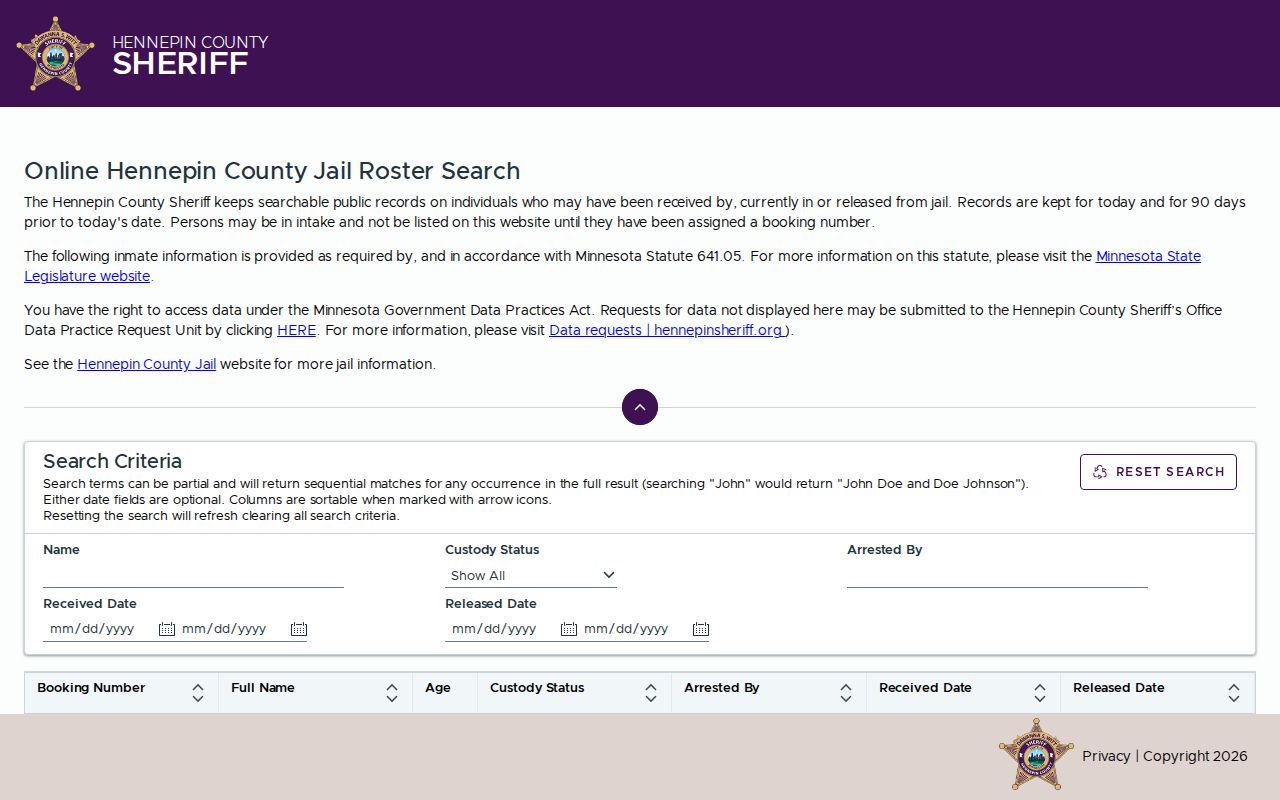
The form’s narrow coverage and date filters are a reminder to identify the system and retrieval time before describing any result.
Historical Minneapolis Resident Directories
Hennepin Library’s digital Minneapolis city-directory run spans 1859 through 1963. The same local program has Minneapolis Area Phone Books for 1933 through 1975 and Yellow Pages for 1933 through 1963. City directories may be searched by name or address, which is especially useful when a surname is hard to read in OCR. They record an association with an address at publication, not a promise of a permanent or current home.
Minneapolis directories were issued annually or biannually as early as 1859, with changing titles and publishers. Search the hit, the scan around it, and nearby directory years. A full Minneapolis city directories treatment explains the collections, reading abbreviations, and household tracing in more detail.
- Roll
- A list kept for a particular administrative purpose, not a universal list of residents.
- Index
- A finding tool that points to a record or image and may not contain the whole underlying document.
- Criss-cross directory
- An address-first directory used to find a listed household from a street address.
- Parcel
- A defined piece of land identified by a county property record and legal description.
Minneapolis Library Searches Go Beyond Directories
Hennepin Digital Collections and the library’s Special Collections hold more than directory volumes. The local history trail includes permit cards, lot surveys, maps, photographs, aerials, atlases, plats, and Sanborn maps. Permit cards cover 1884 through 1973, and the collection can be searched when a structure history is more useful than a person name.
Hennepin History Museum archives add newspapers, photographs, maps, letters, blueprints, diaries, yearbooks, and postcards. These sources can corroborate a historic address or family without claiming that an old entry identifies a current resident. Keep the publication year, collection title, and search date with each result.
Minneapolis Vital Records Have Different Doors
Minnesota Department of Health Vital Records controls statewide record information, while Hennepin County provides local birth and marriage copy channels. Birth records are generally public after 100 years. Death records are public informational or noncertified records, while certified copies have eligibility limits under Minn. Stat. §144.225. A vital index can locate a record but is not the same as a certified copy.
For a marriage lead, the statewide MOMS index and Hennepin County marriage route use different search and ordering functions. Hennepin’s stated county charge is $9 per item, and an exact date is preferred. The right route depends on whether the goal is an index reference, an informational record, or a copy for someone eligible to receive it.
Minneapolis ZIPs Are Not Resident Boundaries
USPS ZIP Code Lookup can verify an address, find ZIP codes for a city, or look up a ZIP’s delivery information. ZIP geography is made for mail delivery. It does not define a Minneapolis neighborhood, ward, tax parcel, school boundary, or city limit. The central range includes low 55401 through 55405 codes, while other codes span south, north, northeast, west, and shared suburban service areas.
Use the full street address and source date when a postal code narrows a search. Some Minneapolis-related codes are shared, specialized, or associated with government or university delivery. A ZIP can be accurate even when the postal city and municipal boundary do not match.
Minneapolis Safety Rules Shape the Record Trail
Minnesota’s Data Practices Act presumes government data are public unless another law classifies them differently. That rule works alongside limits for court, voter, vital, law-enforcement, and address-confidentiality records. Safe at Home gives eligible participants a designated mailing address and requires covered entities to accept it where permitted. A designated address is never evidence of someone’s physical location.
Use records for lawful personal research, family history, civic transparency, or estate questions. Do not harass, stalk, intimidate, or expose a protected address. The safest practice is also the most useful one: say exactly what a dated source shows, retain its limits, and ask the custodian to correct a record rather than trying to reconstruct protected information elsewhere.
Note: Hennepin portals and public indexes change over time, so confirm access rules and result scope with the named custodian before relying on a record.
Minneapolis Results Need a Date Check
Different Minneapolis records update on different schedules and describe different moments. Hennepin property information is updated on weekday nights. Voter data update nightly, but processing can take longer to appear. Court, recorder, library, and jail systems each have their own index and retention limits. A result from one system can be useful even when it does not match a newer result from another system, provided the dates and record purposes are clear.
Keep a short research log with the exact spelling searched, address form, parcel ID or case number when available, filters used, source URL, and retrieval date. For a historic household, compare the directory year with adjacent years, a permit card or map, and a deed or tax record. For a current property question, compare the parcel data with the recorder instrument instead of guessing from a name alone.
The same care prevents false negatives. No MCRO name result is not the same as no court history. A missing directory hit may be an OCR problem, a listing under initials, a move, a publication gap, or an omitted person. A scoped negative result is more honest and more useful than a broad conclusion.
Minneapolis Directory Collections Keep Expanding
Hennepin Library reported in 2026 that its digitized Minneapolis directory collection covers the 1859 to 1963 city-directory run, with phone books and Yellow Pages in separate date ranges. Its 2025 archival work also included neighborhood-related collections, high-school newspapers, and Hennepin County communications photographs. That growth makes it worthwhile to repeat a historical Minneapolis residents directory search later, while preserving the date and collection scope of the original result.